
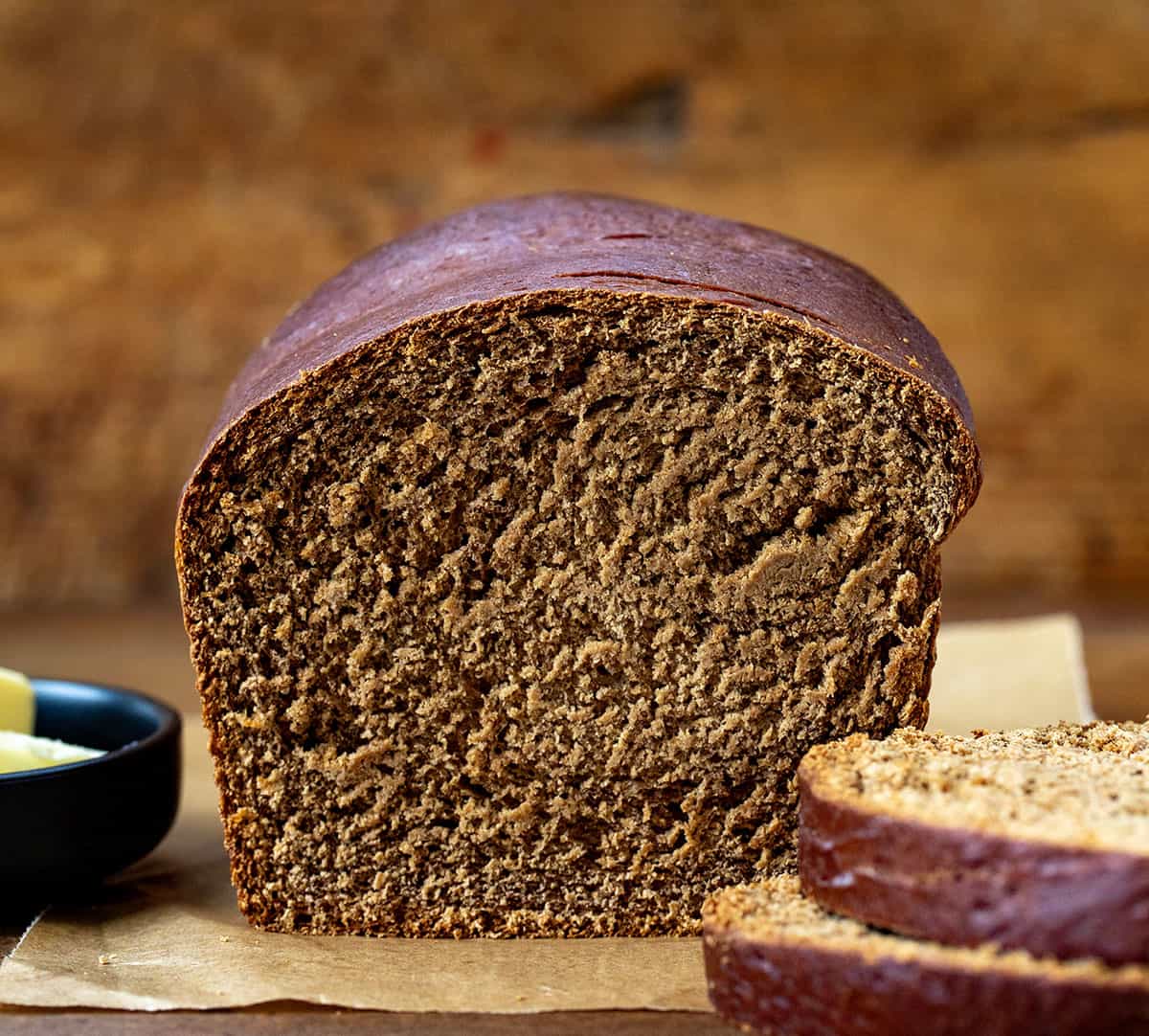
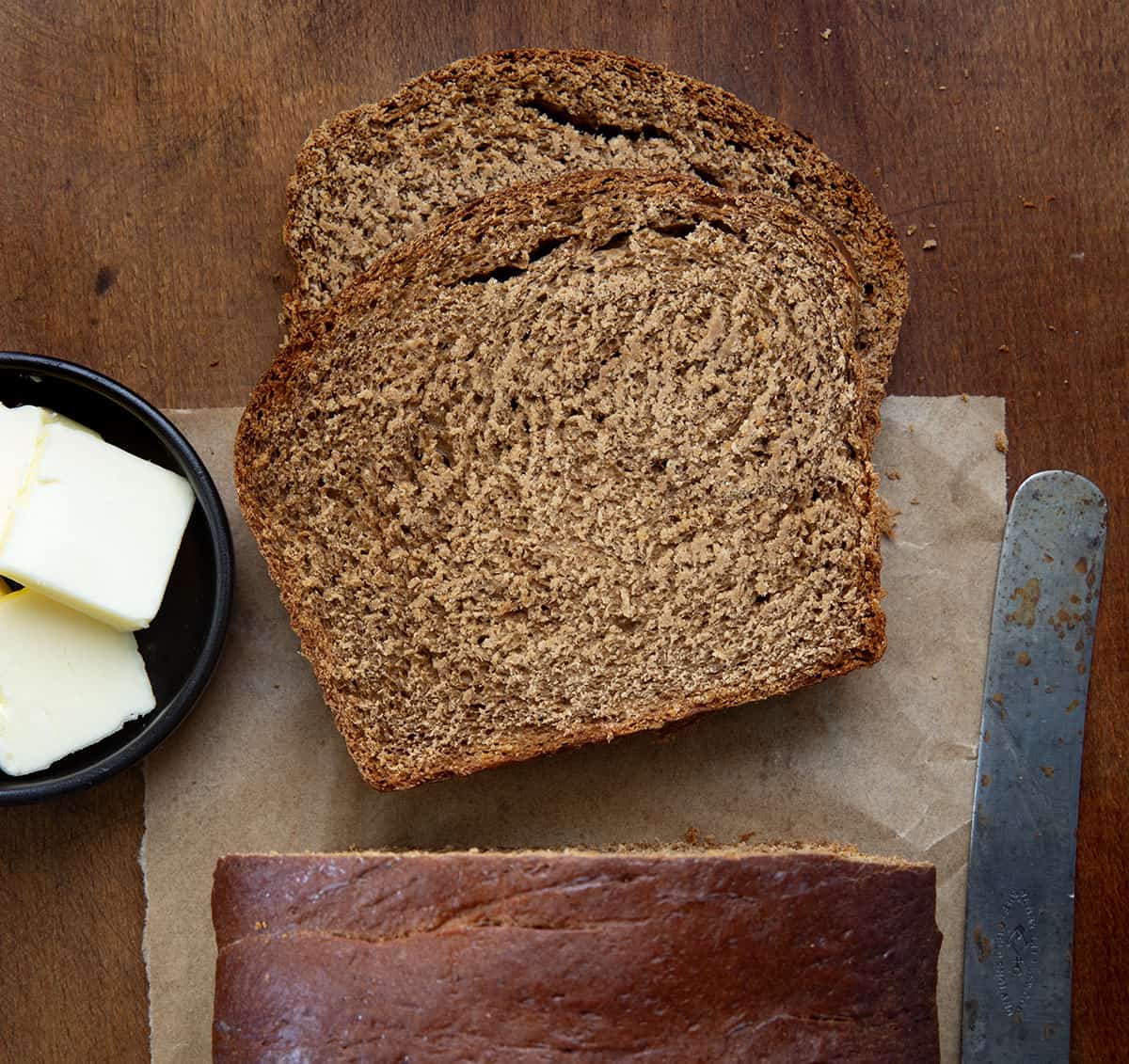
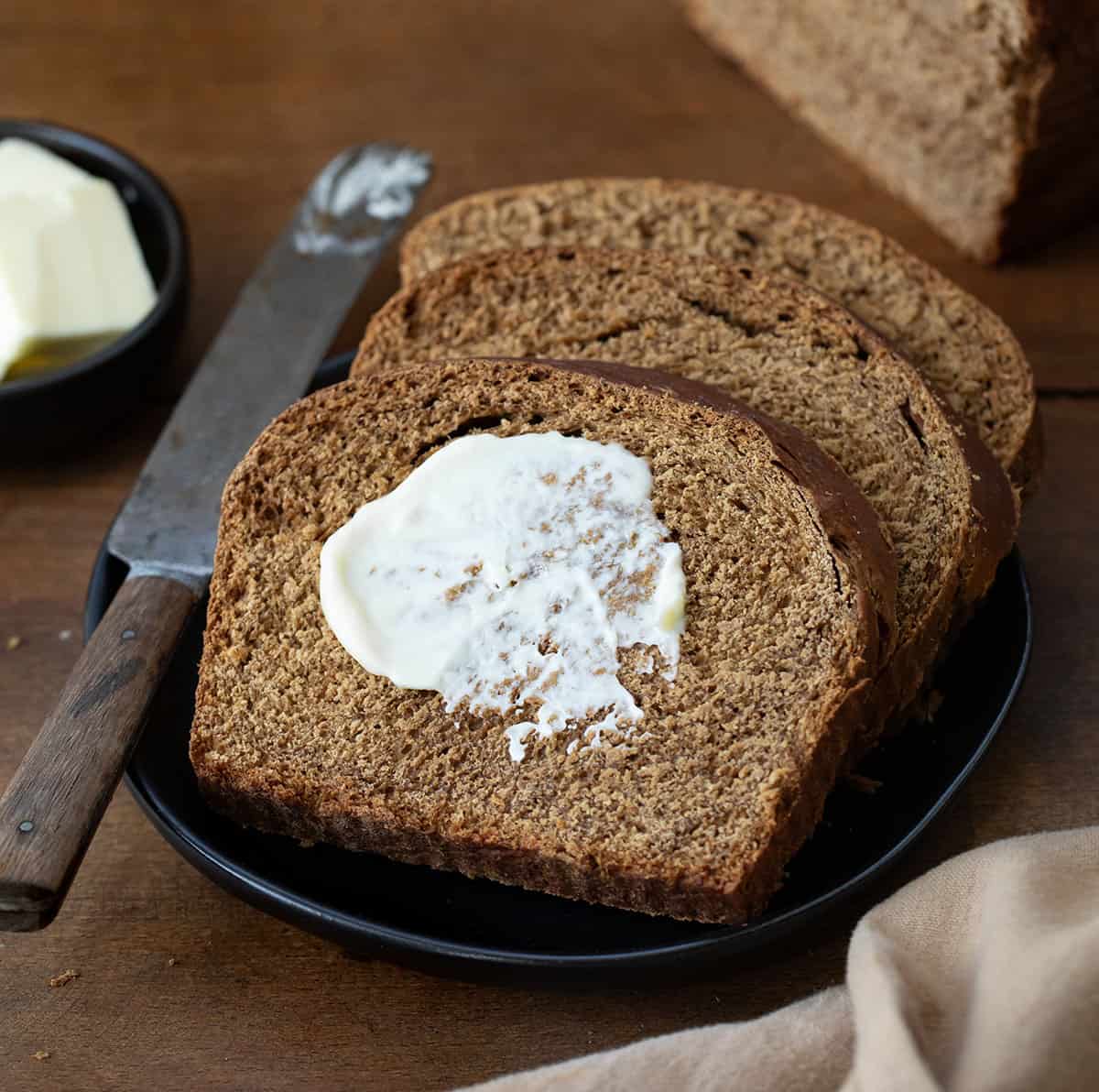
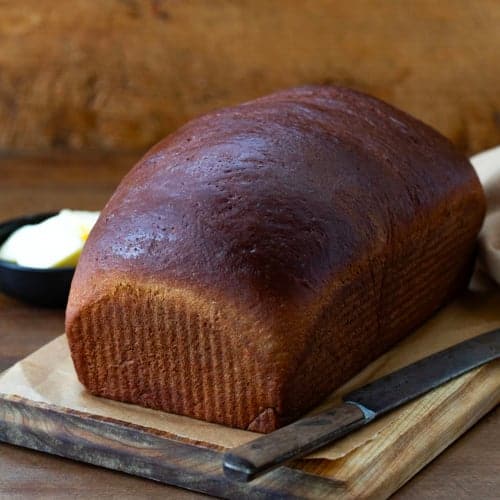
This homemade Pumpernickel Bread is a rye bread that has a rich, slightly sweet flavor with a dense, hearty texture. I warmed up a slice and added a little butter, and it was delicious! I really love how the molasses stands out in each bite. It’s also perfect for sandwiches or alongside a bowl of soup or stew. If you’re looking for a lighter, more versatile bread, my homemade simple white bread recipe offers a soft, tender crumb that’s perfect for everyday use.
What Is Pumpernickel Bread?
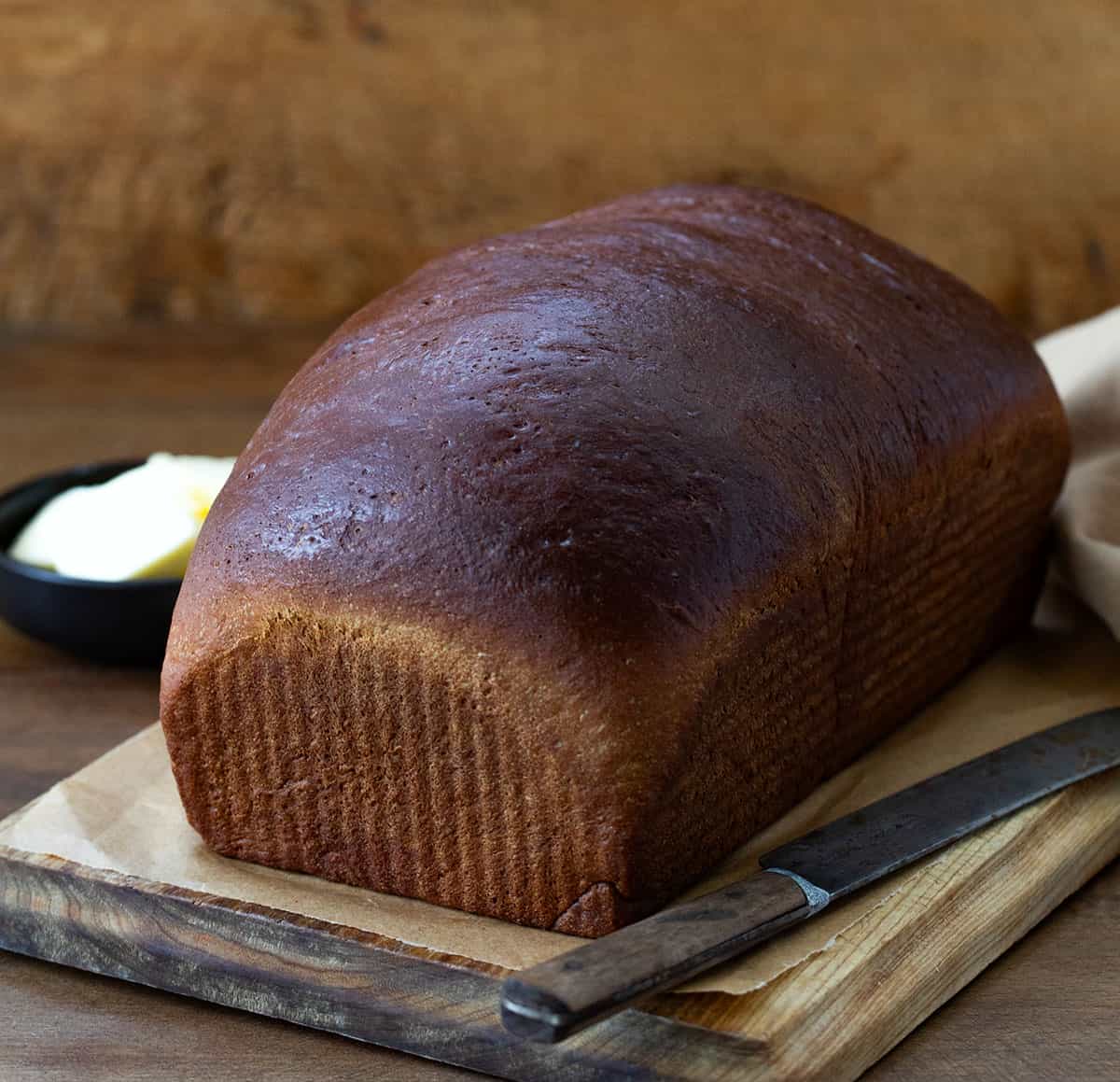
Pumpernickel bread is a dark, dense rye bread traditionally made with coarse rye flour. It often involves a long, slow baking process, and can use a sourdough starter instead of yeast for the rise. This recipe is a more modern way to make pumpernickel bread, especially in the United States. It calls for a mix of flours and adds cocoa powder and molasses to make it taste richer and sweeter and give it that dark color pumpernickel bread is known for.
Ingredients & Substitutions
- All-Purpose Flour: The majority of the flour in this recipe is all-purpose. It gives the bread structure and helps balance the density of the bread. I mean, I love dense bread, but there is a limit–we don’t want it too heavy!
- Bread Flour: Bread flour has a higher protein content than all-purpose. This helps give the bread a chewier texture, which is perfect for a loaf like pumpernickel!
- Rye Flour: For the distinctive pumpernickel taste, we can’t leave out the rye flour! I used medium rye, but you could use light rye for a milder rye flavor. Or, if you don’t have any rye flour, you could substitute whole wheat flour.
- Cocoa Powder: Look for regular unsweetened cocoa powder. It helps give the bread its rich, deep color and adds a little flavor.
- Yeast: I like using instant yeast–just mix it with the flour, cocoa powder, sugar, and salt. No need to proof! The granulated sugar feeds the yeast while the tablespoon of kosher salt helps to keep the yeast ‘in check’, as I would say–slowing down the activation for a more uniform rise. And, make sure the water is between 105°F and 115°F.
- Molasses: I love tasting the molasses as it comes through in this bread. It also helps keep the bread moist and gives it a darker color. You could substitute honey or maple syrup, but the flavor and color of the bread will change.
- Oil: Vegetable oil helps soften the bread by adding moisture to the dough.
Can I Make Pumpernickel Bread In A Bread Machine?
Yes, but if using a bread machine, be sure to add the ingredients in the correct order (according to your machine). Then, if the machine has it, use the whole grain or rye bread setting. If not, use the basic or whole wheat cycle. Let me know how it turned out!
How To Store Pumpernickel Bread
If you are planning to eat the pumpernickel loaf within a few days, store it at room temperature. Here is how:
- Keep the bread in a dark place, away from sunlight. Wrap the loaf in plastic or aluminum foil.
- When you want to cut a slice of bread, first cut the loaf in half from the middle, not the end. After cutting a slice or two, put the two halves back together to keep the cut end from drying out.
- Eat the bread within 2-3 days. If you can’t finish it, the best option is to freeze it.
Freezing Bread
To freeze this pumpernickel bread:
- Let the bread cool completely.
- Wrap the loaf (or portion of the loaf) in plastic wrap; then, store it in a sealed plastic bag.
- Place the bread in a colder part of the freezer, away from the door.
When ready to enjoy the bread, remove it from the freezer and unwrap it. Store it in a zipped plastic bag at room temperature.
Pumpernickel Bread
Ingredients
- 2 ½ cups (312.5 g) all-purpose flour
- 1 cup (127 g) bread flour
- 1 cup (102 g) medium rye flour
- 2 tablespoons unsweetened cocoa powder
- 5 teaspoons instant yeast
- 1 tablespoon granulated sugar
- 1 tablespoon kosher salt
- 1 ½ cups warm water, 105°F-115°F
- ½ cup (168.5 g) molasses
- 2 tablespoons vegetable oil
Instructions
- Spray a 9×5-inch loaf pan with nonstick cooking spray. Set aside.
- To a large bowl, add all-purpose flour, bread flour, rye flour, cocoa powder, yeast, sugar, and salt. Whisk to combine.
- In the bowl of a stand mixer fitted with a dough hook attachment, mix together the warm water, molasses, and vegetable oil.
- Gradually add the dry ingredients to the wet ingredients. Mix on low speed until a dough forms, 1-2 minutes.
- Knead for 5-8 minutes, until the dough is smooth and elastic. Alternatively, you can turn the dough out onto a lightly floured surface and hand knead for about 8-10 minutes.
- Place the dough in a large, clean, oiled bowl and cover. Let it rise in a warm place until doubled in size, about 60-90 minutes.
- Once the dough has risen, roll it out onto a lightly floured work surface. Flatten the dough into a rectangle, roughly the width of the loaf pan.
- Starting at the short end, roll the dough tightly to form a log, pinching the seams as you go to create a tight surface.
- Place the rolled dough seam-side down into the prepared pan.
- Cover and let the dough rise in a warm place until it has doubled in size, about 45 minutes.
- Preheat oven to 375°F (190°C) as the dough completes its second rise.
- Bake the loaf for about 50-55 minutes, or until the bread sounds hollow when tapped.
- Remove the bread from the oven. Let it cool completely on a wire rack before slicing.
- Store the bread at room temperature for up to 3 days or freeze for up to 8 weeks.
Did you make this recipe?
Thank you for making my recipe! You took pictures, right? Well go ahead and post them on Instagram! Be sure to mention me @iambaker and use the hashtag #YouAreBaker.
What the Test Kitchen had to say about this recipe:
This was good! I like how the recipe is pretty straightforward and the texture is dense and chewy.

Elizabeth
Oh, wow, I loved this bread! It was nice and dense (which I love) and had the subtle molasses/rye flavor.

Annabelle
On it's own, I thought it was lacking in flavor a bit, but toasted, with a little butter, it was great!

Bella
This was the first times I tried pumpernickel bread, and kind of liked it! It wasn't too strong in taste, which I thought it might be.
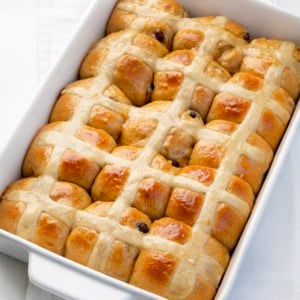
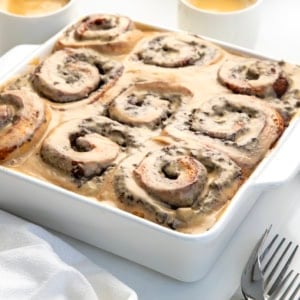










As with Laureen and Mary Beth, I’d like to try making the bread in a Dutch oven and also into dinner rolls, and also add raisins… I’ve never made pumpernickel bread before so I’d have to buy bread flour and rye flour also, and I’d love to make it my way, if possible! I don’t have a 9×5 loaf pan (I do have a ceramic smaller 8×4 pan though).
Lovely recipe. But one must have TWO 9×5 loaf pans ready. One will not hold all the dough this recipe makes. I was happily surprised to get twice as much pumpernickel as I expected.
This recipe is for one 9×5 pan.
I’ve never made pumpernickel bread before and I was worried about how it would turn out. Followed the recipe exactly and it came out perfect. It looked dense but it was anything but. Super light and fluffy with a great flavor. 10/10 would make again in a heartbeat.
Quick question:
After rolling the dough out to the rectangle you say to roll it up starting from the short end. Just to clarify, that is the 5″ wide end as it is roughly a 5×9 rectangle. Correct?
Yes, you’ve got it right… start rolling from the 5-inch (shorter) side. That’s what gives you the proper loaf shape and the correct height once it rises and bakes.
Love it. Thanks for the quick response. Just pulled it out from the first rise and getting ready to roll it out!
Hi Amanda,
Getting ready to make your pumpernickel bread for the first time.
Do I take it OUT of the pan to cool on the wire rack, or leave it in the pan on the wire rack?
Thank you.
Alexis
Hi Alexis!
Great question… once the bread is done, go ahead and take it out of the pan and let it cool directly on a wire rack. That keeps the bottom from getting soggy and helps the loaf cool evenly.
Attempted this in the bread maker according to the instructions! It came out perfect! Also saved me a lot of time!
Good to know! Thanks 🙂
Hi Amanda, I’m making your bread right now. I didn’t use the bread flour, only AP and the Rye flour, let’s see how it turns out. I’ll let you know. I love pumpernickel breads and I put one tsp of caraway seeds too. Looks really good!
I am baking some pumpernickel loaves now. But I only had 9×4 glass pans my mom said it should be fine if I cook it at 350 what say you
A 9×4 pan will work, but it’s slightly smaller than the 9×5 pan the recipe is written for, so the loaves will be a bit taller and may need a little extra bake time. Since you’re using glass, I’d recommend baking at 325°F instead of 350°F and checking for doneness toward the end to avoid over-browning.
Hi Amanda, I only have dark rye flour, will this work for this recipe?
Dark rye flour will work, but it won’t give you the same result as written. Pumpernickel bread uses a combination of flours and cocoa/coffee for flavor and color, while dark rye has a stronger rye flavor and different structure. You can substitute it, but expect a denser loaf with a more pronounced rye taste.
Is this the result of I substitute all the flours with dark rye or just the rye flour? I have AP and bread flour as well, I just meant subbing the medium rye for light rye! Sorry for the confusion!
for dark rye not light rye*
Thanks for clarifying! If you’re only substituting the medium/light rye flour with dark rye and keeping the AP and bread flour as written, the bread will still work well. The loaf may be slightly denser with a stronger rye flavor, but it won’t be drastically different. 🙂
Bread came out ok. Imended up doing a round loaf. It isn’t a bad reciepe